


Key Takeaways
- AI adoption in law firms is progressing through distinct stages, from manual workflows to fully integrated AI-native operations.
- AI-native law firm solutions extend automation beyond internal tasks and into structured client communication across the case life cycle.
- Firms that rely on client-facing AI systems can improve responsiveness and consistency without increasing administrative headcount at the same pace.
- Firms like Frontier Law Center illustrate how AI adoption in law firms is shifting from isolated experimentation toward infrastructure-level integration.
Artificial intelligence is now part of everyday conversations in legal tech. Most firms are exploring it in some capacity: testing tools, improving workflows, and looking for ways to operate more efficiently.
But AI adoption in law firms is not happening evenly. Some firms are experimenting with isolated solutions. Others are building more integrated systems. A smaller group has started to rethink how work flows through the firm altogether, especially when it comes to client communication.
Firms like Frontier Law Center fall into that last category. Their experience reflects a broader pattern: Adopting AI is more than a single step. It is a progression.
Understanding that helps clarify where your firm stands today and what comes next.
Stage 1: Traditional Manual Firms
At the earliest stage, firms rely heavily on manual processes to manage client communication and case intake.
This often includes:
- Phone-based intake handled by staff
- Email chains for follow-ups and updates
- Manual document collection and tracking
These workflows are familiar and flexible, but they come with tradeoffs. Response times depend entirely on staff availability. Information can be incomplete or inconsistent. Follow-ups are easy to miss when workloads increase.
For small and mid-size firms, this creates a direct constraint on growth. Missed calls and delayed responses can mean lost opportunities. Administrative work also consumes time that could otherwise be spent on legal tasks.
At this stage, scaling the firm typically means adding more people.
Stage 2: Digitally Enabled Firms
The next stage introduces digital systems that improve organization and visibility.
Firms begin adopting:
- Practice management platforms
- Digital intake forms
- Document management systems
These solutions bring structure. Information is centralized. Intake becomes more standardized. Documents are easier to manage and retrieve.
This is an important step forward, but the underlying workflows remain largely the same. Staff still respond to inquiries, review submissions, and follow up with clients. Client communication continues to operate on a reactive basis: A client reaches out, and the firm responds when someone is available.
Efficiency improves, but the workload remains tied to human coordination.
Stage 3: AI-Assisted Firms
In the third stage, firms begin incorporating AI-powered tools into their internal workflows.
Common examples include:
- Legal research assistants
- Drafting and summarization systems
- Contract analysis platforms
These solutions help lawyers complete work faster and reduce the time spent on repetitive tasks. This is where many conversations about AI-powered tools for law firm communication begin, although in practice, most of these systems still operate internally.
At this stage, the firm becomes more efficient, but only within its existing structure. The way the firm interacts with clients does not fundamentally change. Intake, follow-ups, and communication still rely on staff to initiate and manage each step.
This is often where firms begin to notice a gap. Internal productivity improves, but delays and inefficiencies tied to communication remain.
Stage 4: AI-Native Firms
The next stage reflects a broader shift in how firms think about AI.
Instead of focusing only on internal productivity, AI becomes part of the firm’s operational infrastructure.
This is where AI-native law firm solutions come into play.
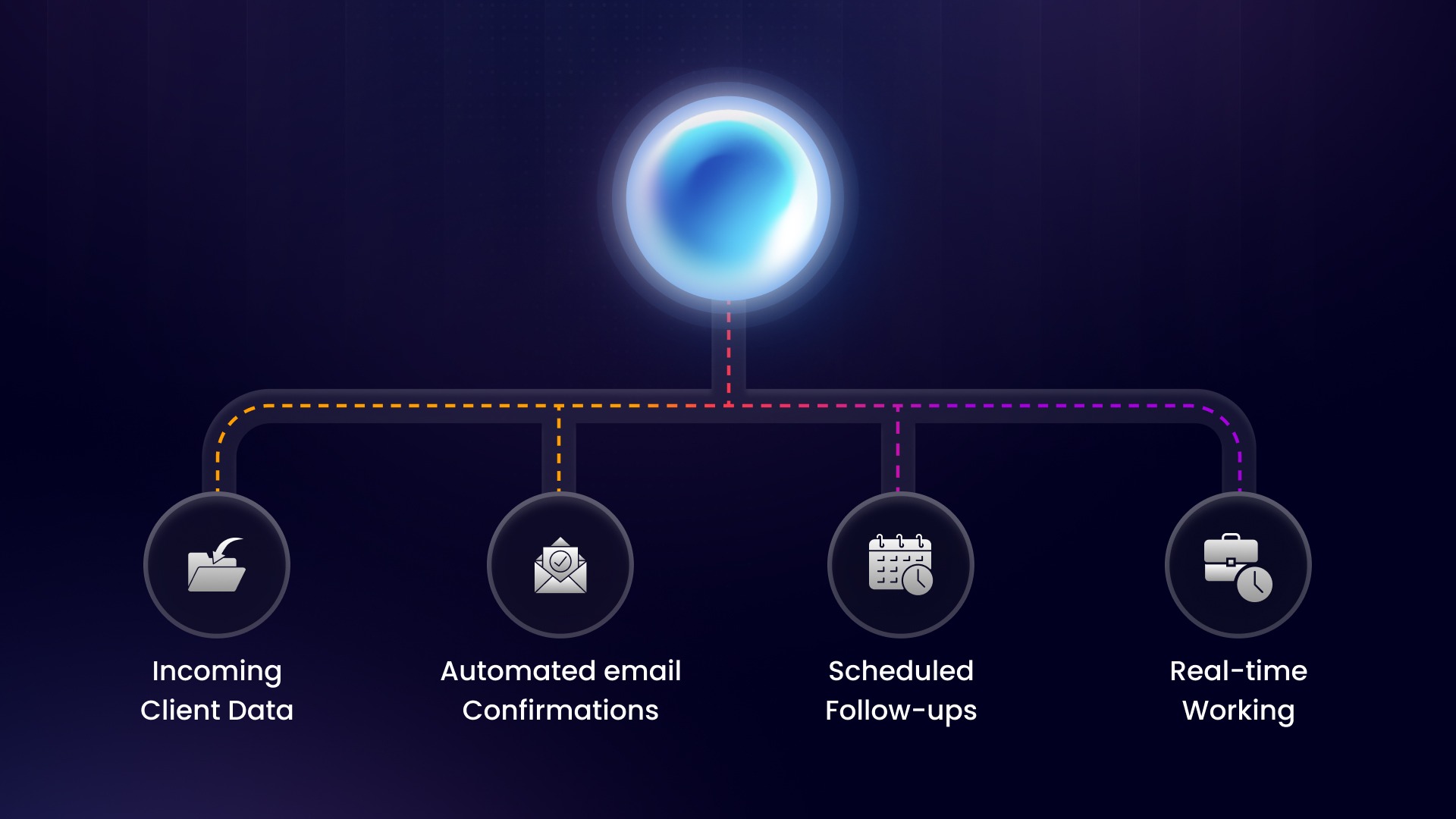
In an AI-native firm, automation extends into client communication. Systems handle structured interactions with clients across multiple stages of a case, including:
- Intake conversations that gather case details
- Document and evidence collection
- Follow-ups and reminders
- Ongoing status updates
Firms that have reached this stage approach a core question differently: How do you automate client communication in a way that remains structured and reliable?
The answer lies in systems designed around defined workflows. AI agents guide conversations toward specific outcomes and escalate when needed. Communication continues without requiring constant staff intervention, while still operating within clear boundaries.
Firms like Frontier illustrate what this looks like in practice. Rather than treating AI as a set of isolated tools, they have integrated it into how communication flows across the firm. Intake, follow-ups, and ongoing case interactions are supported by systems that maintain consistency and momentum.
Solutions like Trailmate are built to support this model, enabling structured client communication across the full case life cycle. The value comes from connecting each stage into a continuous process rather than treating them as separate tasks.
This is what distinguishes AI-native firms. More than simply improving how lawyers work, AI is shaping how the firm operates.
Why Most Firms Are Still Early in the Journey
Despite growing interest, most firms remain in the initial stages of this model. There are several reasons for this:
- Reliability: Firms want to ensure that systems behave predictably, especially when interacting with clients.
- Terminology: Many platforms are marketed as “AI agents,” even when their capabilities differ significantly. This makes it harder to evaluate what a system can actually do.
- Data handling: Firms need to understand how information is managed and how control is maintained.
These concerns are valid. They also explain why the adoption of AI for law firm communications tends to move gradually. Firms test new approaches, evaluate results, and expand usage over time.
The Path Toward AI-Native Operations
The progression from manual processes to AI-native operations does not require a complete overhaul. It happens step by step.
Firms move from manual workflows to digital systems. From digital systems to internal AI. And from internal AI to client-facing automation.
The most significant shift occurs when AI becomes part of how the firm communicates with clients. At that point, automation begins to influence responsiveness, consistency, and the overall client experience.
It also changes how firms scale. Communication can expand without requiring a proportional increase in administrative workload.
AI adoption in law firms will continue to evolve. As systems mature, more firms will move toward infrastructure-level integration.
Some firms are already there. And their experience is starting to define what the next stage of legal operations looks like.
Artificial intelligence is often discussed in terms of capability — what it can automate, accelerate, or improve.
But for most law firms, the real question is more practical: What does it actually look like when AI is embedded into day-to-day work?
Firms like Frontier Law Center offer a useful lens into that question. Rather than treating AI as a collection of internal tools, Frontier has integrated client-facing systems into the flow of work itself, particularly across intake, document collection, discovery, and ongoing communication.
The result is a connected set of workflows that move cases forward with less manual coordination.

