


Key Takeaways:
- Legal process automation is becoming more effective when firms connect intake, discovery, and client communication into continuous workflows.
- AI streamlining legal document collection helps firms reduce delays caused by incomplete submissions and manual follow-ups.
- Autonomous AI systems for workflow automation allow firms to maintain communication continuity without constant staff intervention.
- Firms like Frontier Law Center illustrate how the AI legal discovery process can begin earlier and operate more proactively.
Artificial intelligence is often discussed in terms of capability — what it can automate, accelerate, or improve.
But for most law firms, the real question is more practical: What does it actually look like when AI is embedded into day-to-day work?
Firms like Frontier Law Center offer a useful lens into that question. Rather than treating AI as a collection of internal tools, Frontier has integrated client-facing systems into the flow of work itself, particularly across intake, document collection, discovery, and ongoing communication.
The result is a connected set of workflows that move cases forward with less manual coordination.
Autonomous Communication in Real Workflows
1. Intake: Structured ConversationsFrom the First Interaction
In many law firms, the client intake process is one of the most resource-intensive stages of a case.
Staff handle inbound calls, gather initial details, follow up for missing information, and try to piece together a complete picture of the matter. Delays are common, and the quality of information can vary depending on how the conversation unfolds.
At Frontier, intake is structured differently.
Instead of relying entirely on manual intake, client-facing AI systems guide prospective clients through a defined conversation. The system:
- Gathers contact details.
- Asks relevant follow-up questions based on responses.
- Ensures that key information is collected before the case is reviewed.
This approach creates consistency without removing flexibility. Clients still engage in a conversational format, but the interaction is designed to reach a specific outcome: a complete and usable intake.
For firms evaluating the client intake process in a law firm, this shift can significantly reduce back-and-forth while improving the quality of initial case data.
2. Document Collection: Reducing Friction in Information Gathering
Once a case moves beyond intake, document collection becomes the next major bottleneck.
Clients may need to provide:
- Contracts
- Messages
- Employment records
- Other forms of evidence
In traditional workflows, this often leads to repeated emails, reminders, and incomplete submissions.
Frontier’s approach focuses on reducing that friction. AI systems handle document requests as part of an ongoing workflow rather than a one-time ask. If a client uploads partial information, the system can prompt for missing items. If no response is received, it can follow up automatically.
This is where AI streamlining legal document collection becomes especially valuable. Instead of relying on staff to track and manage each request, the system maintains continuity.
The process becomes less about chasing documents and more about ensuring that everything needed is collected in a structured way.
3. Discovery: Preparing Information Before It Becomes Urgent
Discovery introduces another layer of complexity.
Many aspects of the AI legal discovery process involve gathering standardized information — background details, timelines, prior records — that are required in nearly every case. Traditionally, this information is collected under time pressure, often through multiple rounds of communication.
At Frontier, these steps are addressed earlier and more proactively.
Client-facing systems initiate structured information gathering as part of the broader workflow. Rather than waiting until discovery deadlines approach, the firm begins collecting required data in advance.
This approach has two effects:
- Information is more complete and easier to validate. Staff spend less time coordinating last-minute requests.
By integrating discovery preparation into earlier stages, the workflow becomes more predictable and less reactive.
4. Ongoing Communication: Keeping Cases Moving Without Constant Follow-Ups
Beyond intake and document collection, one of the most persistent challenges in legal operations is maintaining consistent communication throughout the life of a case.
Clients need updates. Firms need responses. And in many cases, progress depends on timely back-and-forth.
In traditional workflows, this creates a continuous cycle of emails, calls, and reminders. At Frontier, communication is treated as an ongoing system rather than a series of isolated interactions.
AI agents support:
- Status updates at key stages of a case.
- Reminders for outstanding tasks.
- Follow-ups when responses are delayed.
Autonomous AI systems for workflow automation are most visible at this stage. Communication does not stop because a task is incomplete or a message goes unanswered. The system continues to guide the interaction forward within defined boundaries.
For staff, this reduces the need to manage routine communication manually. For clients, it creates a more consistent and responsive experience.
From Tasks to Workflows: What Actually Changes
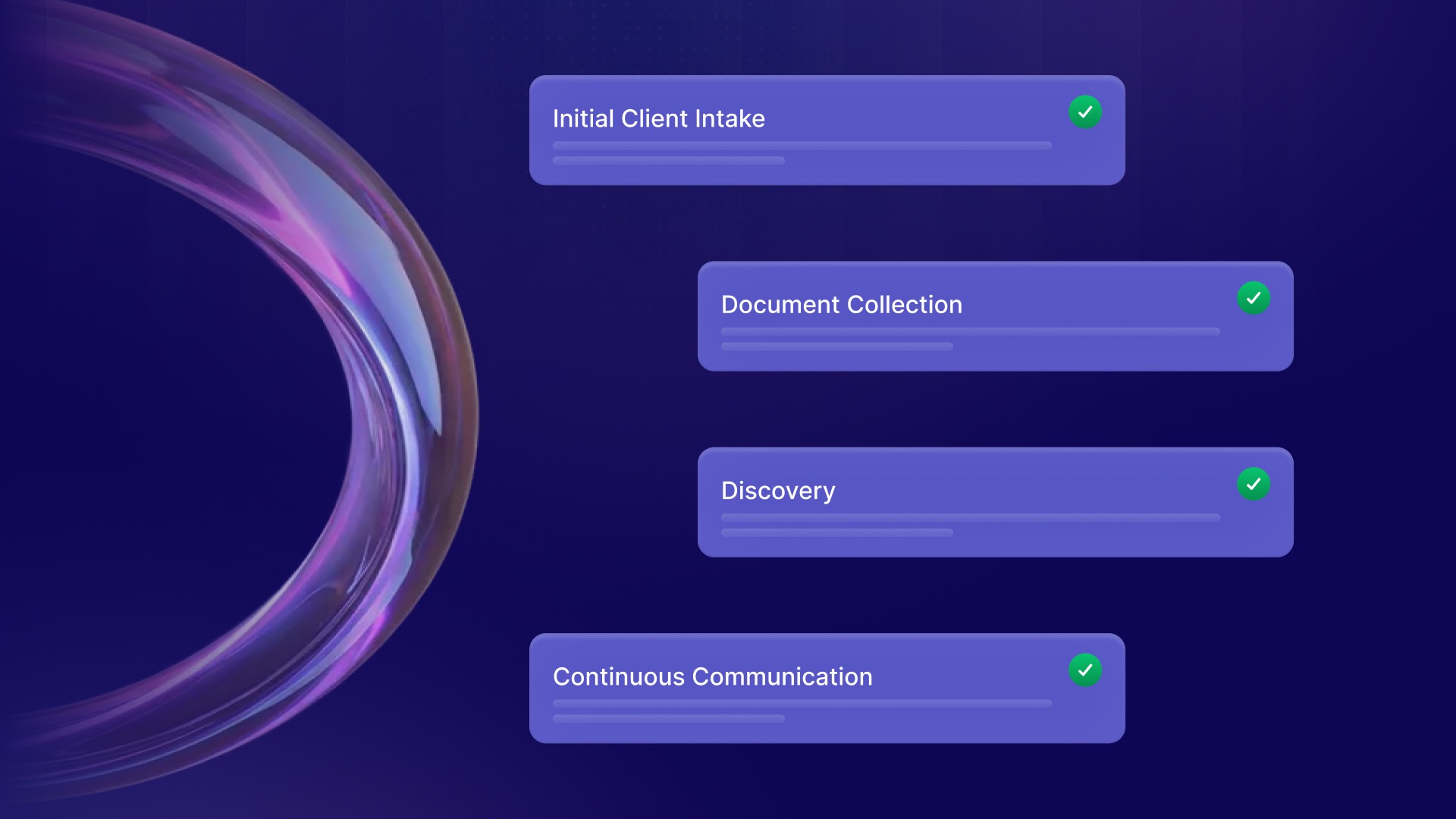
When these elements are combined — intake, document collection, discovery preparation, and ongoing communication — the shift becomes clear.
Here, legal process automation takes on a different meaning. Instead of focusing only on internal efficiency, automation extends into the communication layer that connects every stage of a case.
Solutions like Trailmate are designed to support this kind of structured, client-facing workflow, enabling firms to maintain continuity from initial contact through ongoing case management.
A More Scalable Way to Operate
For firms evaluating how to modernize, the shift happens by identifying where communication creates friction and introducing systems that reduce that burden while maintaining control. In practice, this often starts with intake or document collection, then expands into other parts of the case life cycle.
Over time, the impact compounds:
- Faster response times.
- More complete information.
- Fewer delays caused by missed follow-ups.
- Reduced administrative workload.
AI agents, when implemented this way, keep communication and coordination moving so legal work can progress without delays. And for firms looking to scale without adding proportional overhead, this is what makes it possible.

